|
|
MARS
Planet
Solar System
Old Version - 1, updated Sun, Mar 26, 2017 at 18:29:34, 5215 bytes - by relopez.
This article is for information and educational purposes only and is not
intended to give medical, legal or professional advice.
The fourth planet of our solar system.
|
INTRODUCTION
Mars is the fourth planet of our solar system, the next farther away from the sun after Earth. It is considered by some to be the planet most similar to Earth and the most promising location for establishing an extension of human civilization. Because it contains liquid water in the present and has contained even larger quantities in the past, there has been interest in searching for signs of life and this has been a motivator of some of the missions to the planet.
|
SIZE AND DIMENSIONS
| | Size and Dimensions | | Radius | 2109 mi, 3380.0 km. | | Surface Area | 56 million square miles, 144 million square kilometers, 36 billion acres. | | Gravity | 38% of Earth |
|
Land
The amount of land on Mars (56 million square miles) is almost the same as the amount of land on Earth (57 million square miles). The Earth of course, is larger, but the oceans cover 139 million square miles.
|
Gravity
The gravity on Mars is 38% that of the Earth's. That means that a 150 pound person would weigh 57 pounds on Mars. This could be a problem for people exploring or settling on Mars. However, it is possible that the force of gravity is enough so that a heavy exercise routine of weight lifting and aerobics could help mitigate the effects of low gravity on the heart, muscles and bones.
|
COMPOSITION
Atmospheric pressure varies depending on the distance of Mars from the sun. The pressure at the Viking Lander 2 site varied between 7.4 to 10.2 millibars. That is about 0.9% the pressure and density of the atmosphere on Earth at sea level and about the same as that on Earth at about 20 miles (32 km) in altitude.
[1]
| | Composition | Atmosphere| CO2 | 95% | | N2 | 2.7% | | Ar | 1.6% | | O2 | 0.15% | | H2O | 0.03% | | Pressure | 7.4 to 10.2 millibars, 0.9% Earth | Soil| O | 44% | | Si | 20% | | Fe | 11% | | Mn | 6.4% | | Mg | 5.5% | | Al | 5.5% | | Ca | 3.4% | | Na | 3.2% | | S | 2.5% | | P | 1.0% | | Ti | 0.7% | | Cl | 0.6% | | K | 0.6% | | Cr | 0.3% | | |
|
CLIMATE AND TEMPERATURE
|
Length Of Day And Year
The Martian day lasts 24.6598 hours, (24 hours, 39 minutes, 35.3 seconds). Martian year lasts 686.98 Terran days, 668.60 Martian days.
Temperature on the Surface: Mars Global Surveyor Thermal Emission Spectrometer data shows that surface temperature varies from a high of about +20 degree Fahrenheit in the lower latitudes to about a low of about -200 degrees Fahrenheit at the poles.
[2]
The temperature at the Pathfinder site varied between -60 at night to 20 during early afternoon during the first few days of the Pathfinder misssion. Lowest measured temperature on Earth is -120 in Antarctica. Click here for a discussion about surviving the intense cold on Mars.
|
Distance From Sun And Seasons
Earth average distance from sun is 152 million km. Mars is 245 million km from sun at its farthest poin (1.61 x Earth), and 207 million km at its closest (1.36 x Earth). Mars has an excentric orbit, so it is closest to the sun during the southern summer and farther from the sun during the souther winter. This gives the southern hemisphere a more extreme climate, making summers warmer and winters colder than in the north. The northern hemisphere has a more constant temperature with warmer winters and cooler summers. It is probably the cooler summers that make the northern ice cap the reservoir of water ice. Whatever water condenses in the southern ice cap during the southern winter evaporates during the warm southern summers and migrates to the north. The warmer brighter summers would make agriculture easier in the south, but the winters would be more intolerable. Therefore, farming communities might develop in the southern hemisphere while the larger population centers might develop in the north where temperatures are more constant. Of course, Mars is cold everywhere (see above).
|
|
Inclination of Equator to Orbit: Mars is spining at an angle very similar to that of the Earth giving Mars seasons. A person standing on Mars would see the sun at an angle similar to that on Earth during the same time and season. However, the sun would be 2/3 as large, and half bright. Inclination of Earth to its orbit is 23.45 deg, and for Mars it is 25.20 deg.
|
MOONS OF MARS
Mars has two moons which are likely captured asteroids. The closest and largest is Phobos and the farther and smaller one is Deimos.
| 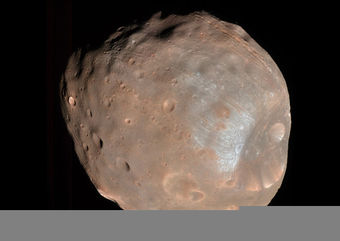 Photo of Phobos
|
KEYWORDS
The following keywords are alternate terms which can be used to access this page.
mars, ares, martian
|
SEE ALSO
Phobos
Deimos
|
REFERENCES
1 Zubrin, The Case for Mars: The Plan to Settle the Red Planet. (New York: Free Press, 1996), .isbn13: 9781451608113,
2 Zubrin, The Case for Mars: The Plan to Settle the Red Planet. (New York: Free Press, 1996), .isbn13: 9781451608113,
|
BIBLIOGRAPHY
-- Zubrin, The Cases for Mars: The Plan to Settle the Red Planet. (New York: Free Press, 1996), .isbn13: 9781451608113,
|
|
|
|
top
|


